Showing posts sorted by relevance for query mugonkan. Sort by date Show all posts

10/29/2023

Mugonkan revisited

A couple of days ago, I visited Mugonkan, the Wordless Museum for the Young Painters Killed in WWII, in Nagano. It was the 3rd trip there for me. I have posted the article for each visit in the past. 


 https://nuttycellist-unknown.blogspot.com/search?q=mugonkan


Getting off the highway near the destination, I drove through the rice paddies on a plain area around Chikuma River. Being several miles far from the river, there were pretty high mountains running along it. It is a wide valley along the river. Some trees were changing their colors on the mountains.


It was a plain week day and there were only few visitors at the museum. Very quiet. The entrance has welcomed me as it used to. As told before, it was on a top of a hill surrounded by trees.


A pallet shaped stone monument. Each painter's name was engraved like a big epitaph.


The museum made of exposed concrete. The museum name was engraved on the front wall above the entrance door. It looked like a church on the hill.


From the entrance way, a town and the rice paddies were seen below.


I have long wanted to return here. I would spend more time to look at the paintings and the painters' short biographies listed with them. 

I knew most of the painters had died in 1945 or in the end of the war. It might be because they have been recruited around that time. They could still have survived the war if it was ended earlier. Nearly half of them have died of some illnesses but not of battle. As with the other parts of the war or in the other areas, this means how poor the logistics were then. With better care, they could have lived until the end of the war.

Each work appealed me with quiet but also overwhelming power. The explanation says most of them have not stopped painting until the last moment they should leave home. I wonder what they have done if they could survive it or they were not deplyed for the military service. 

My father used to dream of becoming a painter when he was young, as I heard in my childhood. But, as told elsewhere, he had to spend his precious time of youth in the war. I have been sorting out the books he owned and have found a lot of books regarding the war and the responsibility of the war in addition to those of Christianity. In his elderly days, one of his concerns was surely in that subject. And those young painters are overlapped with my father. It was only a coincidence he could survive and come home later. Those young painters deceased in the war must have produced a lot of more works and contributed to the art in our country.

Likewise, I could not help thinking of young people in Ukraine and Israel/Gaza. They are talented with a lot of things. But they are forced to struggle in the battle. Some of them would die in the war. Their talents and capabilities would never be realized but would be lost forever. Non war or anti war ideas might be regarded powerless or helpless. But it is still a definite idea influencing on the international policy. Without it, the total war could result in total ruin. Really hope those young people could survive and exert their capabilities very soon.

Like the other people of my age, I am apt to have pain in the legs after a long drive. That was the reason why I had not driven up there. I found it worth going there again this time. Listening to Impromptu by Schubert on the way back home, I uttered to myself this could be the last drive trip there. 

8/21/2025

Mugonkan to be revisited

A musium memorial for the young painters victimized as soldiers during WWII, Mugonkan, that stands for a wordless musium. It is located in Ueda city in Nagano. 


I have been there for 3 times since 2018. Three to four hours drive one way. Not an easy drive but still worth visiting it. 


https://nuttycellist-unknown.blogspot.com/search?q=MUGONKAN


What does it attract me so much? One reason is that the works exhibited there all silently as well as strongly appeal how they had lived and what they would leave to us. As told in another post, they are overlapped with my father who spent young days as they did and had a hope to be a painter.  I also consider of the young people in the wars in Ukraine, Gaza and so forth. Most of them are being killed before realizing their capabilities.  


This is a video clip introducing the museum. It was founded in 1997 by Seiichiro Kubota who had collected the paintings for 20 years. Getting old, he has decided to have it succeeded by the educational institution of Ritsumeikan recently. 


https://www.youtube.com/watch?v=t43WA-O6fQI


I wonder if I could revisit there some day.

8/18/2018

Mugonkan

Mugon kan, how should I translate it into English? It is an art museum which displays the pictures of young art students or of young painters who have gone for compulsory service and died in the WWII. It is in Ueda City in Nagano Prefecture about 4 hours drive from here. I have seen a TV program showing this museum and the pictures displayed there some time ago. It made me feel I would visit there by any means. It was very fine and cool today. The best day for such a drive. The only misjudgement was that it was a week end and the traffic was a bit congested in an area in Nagano. Anyway, I have headed to that museum in the morning today.

It was located on a top of a hill in the suburb of Ueda City, which was surrounded with mountains all around. The building was 50 ft or so away from the parking lot. Only several cars have parked there. Surprisingly, some of them were from Saitama or Kanagawa, almost of the same distance from my home. This may mean it was not very popular among people but still attracted some people not only in the local area but from many places in the country.


This seemed to be a monument of the young painters dead in WWII. Their names were engraved on a palette shaped stone at a corner of the museum.   


The building of the museum was like a church. Not gorgeous but sound and steady appearance. 


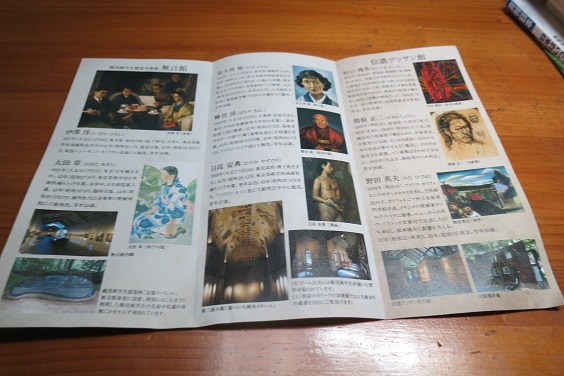
It was forbidden to take photo of the works and letters etc displayed inside. The pamphlet is as follows;


It was dark inside and the pictures and letters were shed light. No noise nor talks. A dosen of people were looking at the works there. They were watching them intently without speaking anything. 

Most works were rather small but sure attracted our eyes. One of nudes was captioned as the model had been the painter's wife and the painter had told he would go on painting it for another 5 or 10 minutes. He was urged to go to war when finishing painting his that very last work and never came back home.

Watching each work, I noticed tears had dropped from my eyes, imagining how regrettable the young painters were leaving their artistic activities and dying away from their families. Most of them were killed within the last 2 years of the war. Some of them were dead due to illnesses in the war. I remembered among 3 million people, soldiers or civilians, killed in the war, more than half of them have died due to illnesses or malnutrition. The nation would treat us in this way once war started. 

Staying quiet there, this museum was much more eloquent against war than any demonstration or any abstract discussion protesting war, I thought. And I believe there were even more talented young people in Asia/Pacific area and in the US/allied countries who had been killed by the invasion of the military of our country in WWII. We should never forget of that fact as well.

Mugonkan stands for a museum without speech. The works and the records of the young painters themselves would move you without any political address or agitation. I thought it was how they had named this museum. In my view, this museum should be called a museum of silent palette. The palettes which won't be used any longer would appeal by themselves what those young people wanted to do.   

On the way back home, I have gone through the concourse before the railway station of Ueda. It was the place where I and company of med school took off a train and tool a bus to a hospital in the mountain area. We have had summer holiday training at that hospital for a few days. Over 40 years ago. Most of us are retiring or have retired from profession. I could not help but remembering what has happened to me in that period. Now I have finished my career as a doctor.


It has undergone a big change since that time. There was still a kind of atmosphere we had had in our medical student days. 

It deserved making this trip even though it was a bit tough one for me. Purchasing some souvenirs to my wife, I headed home on the high way. Sun was already sinking.

4/29/2022

Visiting a museum in Nagano again

Several days ago, I have been to Mugonkan in Nagano, a museum for those young painters or art majoring young students died during the WWII, which I used to visit 4 years ago as in this post. Through the pandemic, I knew it had been in hard time with much less visitors. I wanted to know how it was getting along. Of course, it has been my hope simply to look the paintings exhibited there again. As always, it was already around noon when I decided to drive there. I arrived there late in the afternoon.

The museum building was standing on a hill overlooking the suburb of Ueda city, one of the major cities in Nagano. Among the trees on the hill, we could see the farms there. There were cherry trees along the entrance road to the building. Flowers were almost fallen on the ground. However, close to the building on the north side, there were a few cherry trees still bearing some flowers. 

The building was smaller than I imagined from the memory of the visit 4 years ago. It was exposed with concrete on the outer as well as inner wall. It looked like a church in countryside. Simple and austere outlook. "Mugon" means no words in Japanese. A gorgeous building won't accord with its intention and aim. 


There were only very few visitors in the museum. Looking around the paintings, a mature lady clerk apologetically asked me if I would go on watching them. Yes, it was almost the time of closing. There were no one in the exhibition area of the building. I apologized her and would go out then. At the exit, where the visitors are to pay the fee, I asked them if there had been so many visitors as in the pre-pandemic era. Of course, the answer from the clerk was no. He was asking me where I came from. Only we were talking in the quiet counter. 


After the last visit, I have donated a bit of money to this museum. I have received a hand written mail of thanks from the director later. I found an art book edited and written by him at the exit place. The title is 100 selections of paintings of life. It is composed of the paintings selected and the explanation by the editor. The editor says these paintings are asking us how we are living at present. 


Each painting won't grab our mind and asks us, as the director says, how we are living our lives. Most painters would not stop painting these works immediately before being recruited to the army. 


There are a lot of paintings of self portrait, beloved ones and family members. This painting showing the painter's family and the painter himself, as the painter's brother told, was not real. The family was too poor to have such a time of sitting together at a room. It was what the painter would like to have with the family members. 


On the way back home, I wondered what it attracted me so much. Their arts produced in extremely inhumane situation are really speechless protests against war. Even without considering of the historical situation, they have left those arts as a result of or a process of self-realization which they fight for within limited time span in their lives. In that respect, we are asked by them as for how we have lived and how we are going to live. 


It was worth visiting there again. Maybe, I will do this trip again and spend a full day to watch all the paintings thoroughly.